When it comes to nature conservation in Brazil, conservation areas often serve as a backdrop. They are there, sustaining landscapes, protecting forests, rivers, mountains, caves, sandbanks, mangroves, endangered species, ways of life, and the memories of entire regions. But they don’t always take center stage in the conversation. And perhaps they should.
Conservation areas, also known as UCs, are areas legally protected by the government or, in some cases, by private landowners, established to conserve nature and manage its uses.
In Brazil, they are part of a dedicated system: the National System of Nature Conservation Units (SNUC), established by Law No. 9,985 of July 18, 2000. This law establishes criteria for the creation, implementation, and management of conservation units and organizes these areas into two main groups: Strict Protection Units, focused on nature preservation with indirect use of natural resources, and Sustainable Use Units, which seek to reconcile conservation with the sustainable use of some of these resources.
Not all Conservation Areas operate in the same way
A National Park, an Extractive Reserve, an Environmental Protection Area, a Private Natural Heritage Reserve, or an Ecological Station each have different objectives, rules, visitor access options, and management approaches. What they all have in common is the idea that certain areas require ongoing care, planning, and protection so that they can continue to fulfill their ecological, cultural, social, and economic functions.
Brazil has good reason to recognize the strength of its system. According to the Ministry of the Environment and Climate Change, since the creation of the SNUC, the total area of conservation units in the country has increased by 244.8%. In 2000, 754,000 km² were protected; by 2025, the number of registered units had more than tripled, rising from 1,053 to 3,185. Most of the protected area is in federal units, but states, municipalities, and RPPNs also make up this landscape, showing that Brazilian conservation depends on multiple levels of management.
But no system, no matter how advanced it may be in theory, can stand on its own in reality. And the reality in Brazil is vast, diverse, and complex.
Conservation in Brazil involves dealing with a vast territory, biomes that differ greatly from one another, economic pressures, land-use conflicts, climate change, historical inequalities, traditional territories, a lack of infrastructure, the need for enforcement, increasing visitor numbers, and, all too often, understaffed teams tasked with immense responsibilities. The management of protected areas involves federal, state, and municipal agencies, management councils, management plans, monitoring, and public participation. The Ministry of the Environment itself identifies the management plan as one of the primary tools for guiding the use of each protected area and its surrounding areas, in addition to recommending systems for monitoring management effectiveness.
This is where tourism comes in: as a concrete way to bridge the gap between society and conservation, generate income, strengthen local businesses, support planned public use, expand environmental education, and foster more responsible relationships between visitors, communities, and protected areas.

Tourism, conservation, and regional development
The most recent data help illustrate this potential. In 2025, 175 federal conservation areas monitored by ICMBio recorded a total of 28.5 million visits, a historic record since monitoring began in 2000. The study “Contributions of Tourism in Conservation Areas to the Brazilian Economy” also estimated that visitation to federal conservation areas generated R$ 40.7 billion in sales, R$ 20.3 billion in GDP contributions, and R$ 9.8 billion in household income. At the same time, the survey itself emphasizes that the growth in visitation brings challenges: it is necessary to balance public use and conservation, invest in infrastructure, manage visitor flows, strengthen environmental education, and monitor impacts.
At Raízes, this relationship between tourism, conservation, and regional development is not an abstract concept. It is reflected in projects, partnerships, and methodologies that view conservation areas as part of a living landscape, where nature, the local economy, culture, governance, and a sense of belonging go hand in hand.
- In southern Bahia, for example, Raízes partnered with Conservation International and WWF-Brazil on the Sustainable Tourism Program in the Abrolhos Terra e Mar region. The region encompasses marine, coastal, and terrestrial environments, fishing and indigenous communities, significant tourism activity, and a landscape marked by the presence of protected areas. The initiative included mentoring for local businesses, resulting in the strengthening of the territory’s conservation units and a sustainable tourism network, with incentives for businesses to participate in FUTURI, the Alliance for Regenerative Tourism established in the territory.
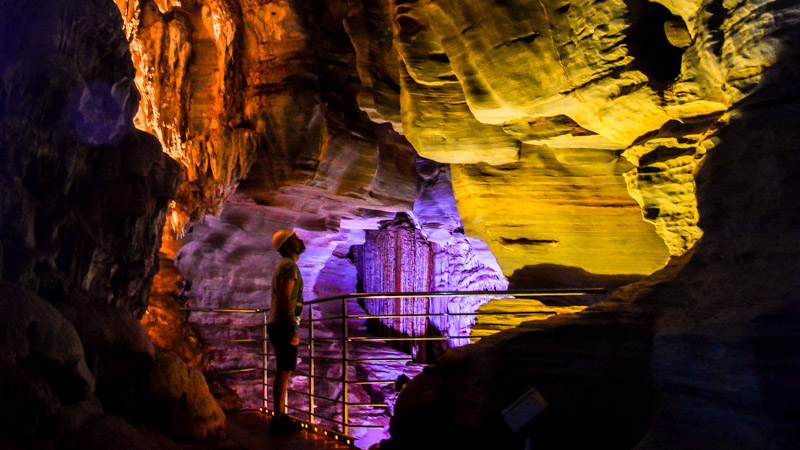
- In Minas Gerais, Raízes also participated in the design of the public-private partnership (PPP) for the Peter Lund Caves Route, a tourist itinerary that includes three conservation areas: Sumidouro State Park, home to the Lapinha Cave; the Gruta Rei do Mato State Natural Monument; and the Peter Lund Natural Monument, home to the Maquiné Cave. The project sought to explore how to make conservation more effective and transform public use into a tool for knowledge and care regarding Brazilian parks. Raízes’ role involved consulting on governance and tourism activities, as well as managing the team of consultants, monitoring deliverables, and coordinating meetings.
- In Espírito Santo, the partnership with Greentec has brought Raízes closer to processes that are fundamental to the management of conservation areas: Management Plans and, within them, the structuring of public use. This is a particularly important area because it defines, based on technical expertise and community input, how people can access, experience, and interact with these areas without compromising conservation goals. When well-planned, public use is not just about visitation. It encompasses environmental interpretation, education, safety, benefit sharing, promotion of local culture, and strengthening of the area.
-
- More recently, Raízes has also been working in partnership with the platform eTrilhas, part of the Brazilian Trail Network, a company specializing in nature tourism, trail development, destinations, and natural attractions. Our contribution has been through classes on Responsible Tourism and Entrepreneurship in state conservation areas in Rio de Janeiro.
- This vision is also linked to Raízes’ work with the MUDA! Collective , which was recently invited by the Semeia Institute to sign, alongside other organizations, the manifesto “Nature Tourism in Brazil: Conservation, Development, and National Pride”. The initiative reinforces the need to make nature tourism a strategic priority for the country, recognizing the role of parks and protected areas in environmental conservation, job and income generation, and cultural appreciation.
These experiences illustrate something that is central to Raízes: conservation is not about isolating the land from life; it is about nurturing the relationships that make conservation possible.
Conservation areas do indeed need legislation, enforcement, and technical tools. But they also need stronger communities, better-prepared local businesses, more conscientious visitors, supported managers, coordinated networks, and projects capable of turning presence into responsibility. Tourism, when it stems from listening and respects the limits of each place, can help in this journey.