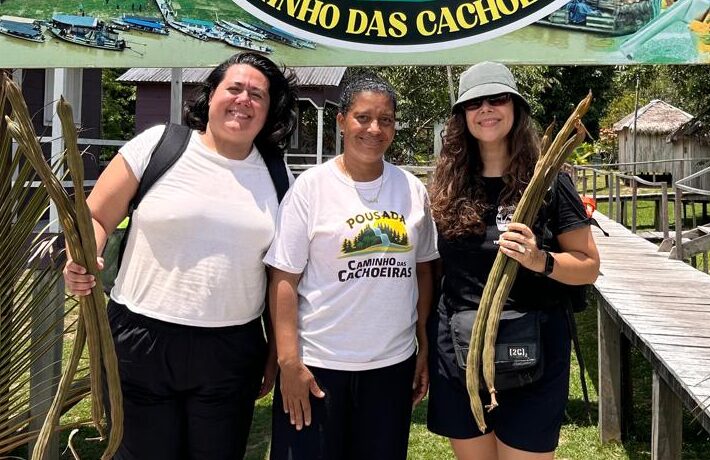
The desire to hear a bird that lives only in a certain part of the world, the curiosity to learn about other ways of life, or to experience forest medicines born of the wisdom of indigenous peoples are reasons enough to inspire a desire to travel. And getting to know the people behind these experiences that spark dreams has been keeping our team busy in Acre, where we’ve begun yet another project to strengthen tourism in partnership with the local community.
In partnership with Sebrae Acre, Raízes is carrying out the Tourism Mentoring Project, which supports 40 businesses in five municipalities: Tarauacá, Mâncio Lima, Cruzeiro do Sul, Rio Branco, and Xapuri. Over the course of six months, the program includes technical visits, individual and group mentoring sessions, and marketing support, with the goal of improving business management and connecting these businesses with audiences interested in learning about the state’s socio-biodiversity.
Leading the coordination effort is Tauana Costa, who participates in the site visits to understand the current status of each business and work with the participants to establish the priorities for this journey. “We reviewed previous documents—since the businesses had already received consulting services from Sebrae—as well as secondary data. Now we’ve been conducting technical visits to get a clear picture of the organization and understand where it stands right now,”she says.

Understand the business, experience the region
The first leg of the visits includes Tarauacá, Mâncio Lima, and Cruzeiro do Sul, with Tauana and Talita Alves, who is supporting the projects in this region as a business mentor. Rio Branco and Xapuri are part of the second region, with Andreia Duarte providing support.
Among the participants are tour operators that offer experiences in indigenous communities, community-run lodges in the Serra do Divisor, urban hotels, restaurants, stalls at the Mercado da Farinha, and even a producer of the innovative Café Amazônico. This variety helps us understand how different activities contribute to the experience of those who visit Acre and what connections can be strengthened among them.
In the Serra do Divisor, visits to lodges also include mapping trails, such as those leading to the lookout point and waterfalls. The project aims to understand the experiences offered, the conditions for hosting visitors, and what motivates people to choose that destination.
On the Crôa River, in the Cruzeiro do Sul region, the team was able to observe the phenomenon known as the “green carpet” during a visit to a development site. Experiencing these attractions up close helps assess both their potential to inspire travel and their role in regional itineraries.
“We also analyze the profile of the tourists who visit these locations, determining whether they are local residents, visitors from other parts of Brazil, or foreigners. This allows us to focus more on segmentation and better target the market,” explains Tauana.

From listening to the strategies of each venture
The program combines in-person and virtual sessions. “The idea is to provide individual benefits to each business by understanding the challenges each one faces, identifying where the project can focus its efforts—like an acupuncture point—over these six months, and determining the business’s vision and expectations,” explains Tauana.
In parallel with the visits, the team from Amplia Mundo—including Jaqueline Gil, Mateus Pinto, and Daniela Nazar—is conducting market research to understand current demand and identify priority audiences. This research will guide the marketing strategies and the organization of the products and services offered by the participants.
And the communications and digitalization initiative, led by consultant Átila Ximenes, has already begun with a group meeting. The project includes one-on-one consultations to analyze the businesses’ presence on Instagram, Google My Business, and other platforms, tailoring their communications to the audience each business aims to reach.
What can be built collectively?
In addition to individual support, the project explores opportunities for collective collaboration among the initiatives. An in-person screenwriting workshop, scheduled for December, will be an opportunity to bring these experiences together and work on developing at least one screenplay that reflects the diversity of the region.
This process involves organizing the product offering, discussing prices and sales channels, and identifying business partnerships that are compatible with the participants’ circumstances. What we learn during each visit helps guide these decisions, bringing market research closer to the day-to-day realities of business.
As we continue our journey to learn more about these stories and the dreams that still need support to take shape, stay tuned here for the latest updates!