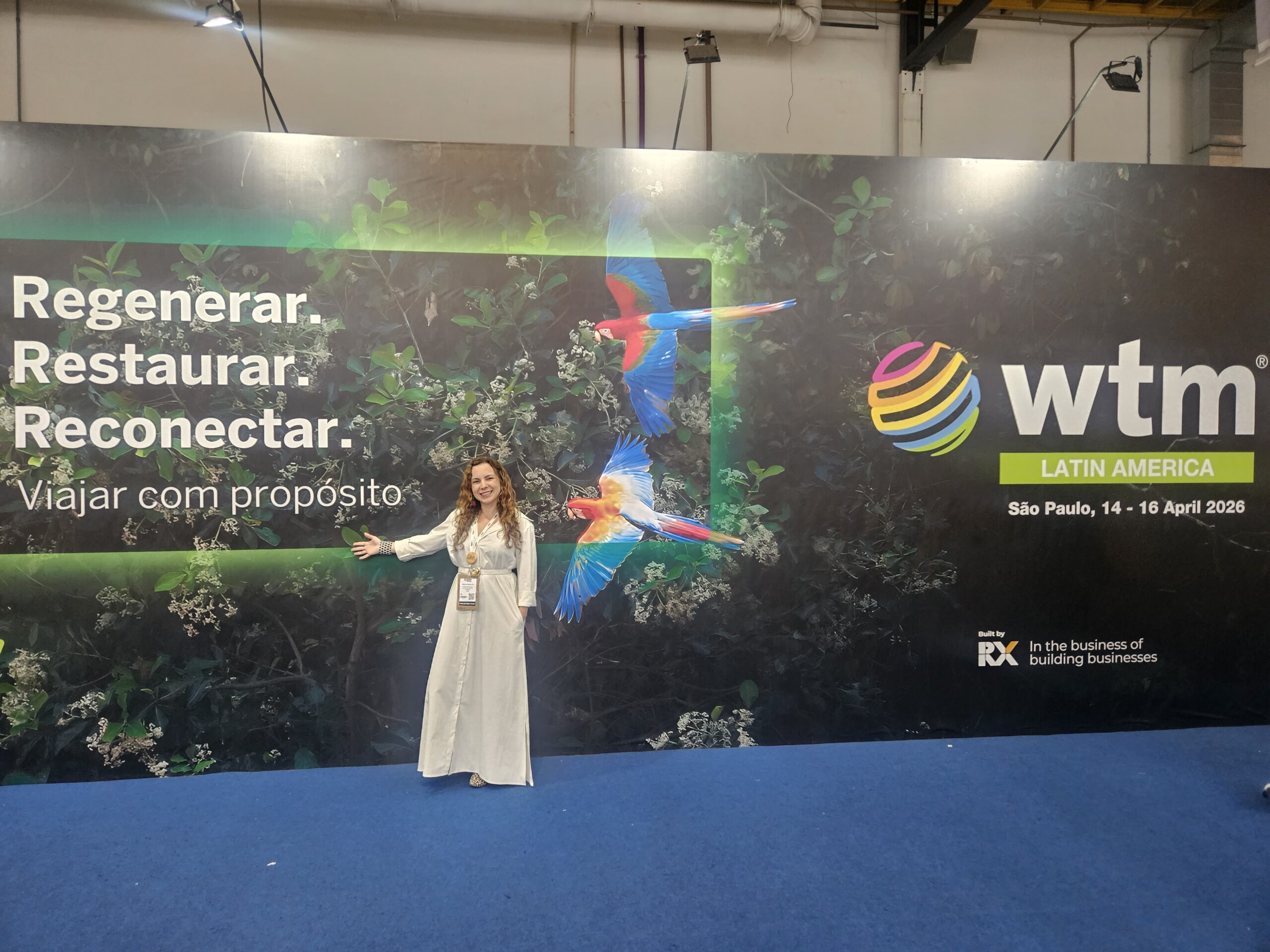
Regeneration in tourism, the central theme of WTM Latin America 2026, cannot be treated as a market trend or as a new label for old practices… It requires profound changes in the way territories are perceived, planned, and experienced. This was one of the main points of consensus from the panel “Tourism Beyond Sustainability: Ongoing Experiences in Latin America for Responsible Tourism”, held at the Transformation Theatre during the event in São Paulo, with the participation of Mariana Madureira, executive director of Raízes Desenvolvimento Sustentável.
Alongside Camilo Alvarado, National Director of Travolution Colombia, and Erika Ramirez, Director of Tours Mitote, Mariana argued that regeneration must take into account social and cultural dimensions, not just environmental ones: “We need to rethink our approach to tourism, so that we can then rebuild relationships, restore memories, and regenerate nature.”
There has been criticism of the mass tourism model, which concentrates income, puts pressure on natural resources, and excludes local residents from economic benefits. In contrast, we advocate for a smaller-scale, more evenly distributed form of tourism, characterized by longer stays, closer relationships, and a more balanced positive impact.
According to Mariana, a consumerist mindset still prevails, turning destinations into products and reducing territories to mere backdrops. To change this paradigm, we need to put nature back at the center and understand that human beings are part of it. “As long as we have such a distorted relationship, we won’t be able to find balance,” she said.
Community engagement as a starting point
 Another central theme of the debate was the importance of active listening to local communities. Participants emphasized that no one truly knows a territory better than those who live there every day. “No one knows the true nature of a territory except the people who live there,” noted Camilo.
This statement reinforces a principle historically championed by Raízes: responsible tourism projects only generate a positive impact when they arise from dialogue with communities, respecting local timelines, memories, vocations, and unique forms of social organization. Instead of seeking grandiose solutions that are detached from local reality, it is more strategic to strengthen community initiatives, existing production networks, local entrepreneurship, and experiences connected to the cultural identity of each region.
Latin American representatives point out that many projects are still conceived in a superficial manner, without meaningful consultation or dialogue with local communities. When this happens, it leads to conflicts, the misuse of resources, and initiatives that are not sustainable in the long term. For this reason, they argue that any proposal related to tourism must take into account the complexity of the territories, their limitations, and their potential.
For this very reason, Mariana, Camilo, and Erika also highlighted the need to involve private companies in this process, provided they are willing to review their practices and learn from community organizations. “We, as communities, have a lot to teach the private sector,” Erika emphasized.
The panel emphasized that models based solely on foreign investment, short-term goals, or financial dependence tend to fail in the long run. In contrast, initiatives built on local autonomy, creativity, and cooperation have greater transformative potential.
Latin America as an inspiration for a new form of tourism
Throughout the conversation, Mariana emphasized that Latin America’s cultural diversity, community ties, and history of resistance can inspire new paths for the global tourism sector. “We need to show the world a new kind of tourism, from a new perspective. A form of tourism that regenerates relationships and territories from a profound place, not through greenwashing,”she said.
For Raízes, participating in events such as WTM Latin America underscores the importance of expanding connections among initiatives committed to territorial development, climate justice, and responsible tourism on a regional and global scale—in this case, in Latin America.

In addition to our activities at the fair itself, we attended the General Assembly of the MUDA! Collective for Responsible Tourism— of which we are a member — on Monday (the 13th) at our office in São Paulo. These are always opportunities to meet professionals we admire, who have also become friends and partners over the years.
Finally: the tourism of the future will not be measured solely by the number of visitors, but by the positive impact it has on those who live in the region!
Did you know we’ve published a free eBook on regeneration? DOWNLOAD IT HERE.