How can community-based tourism contribute to climate justice? And how can the territorial development initiatives we have observed in Brazil inspire public policies and initiatives in other parts of the world?
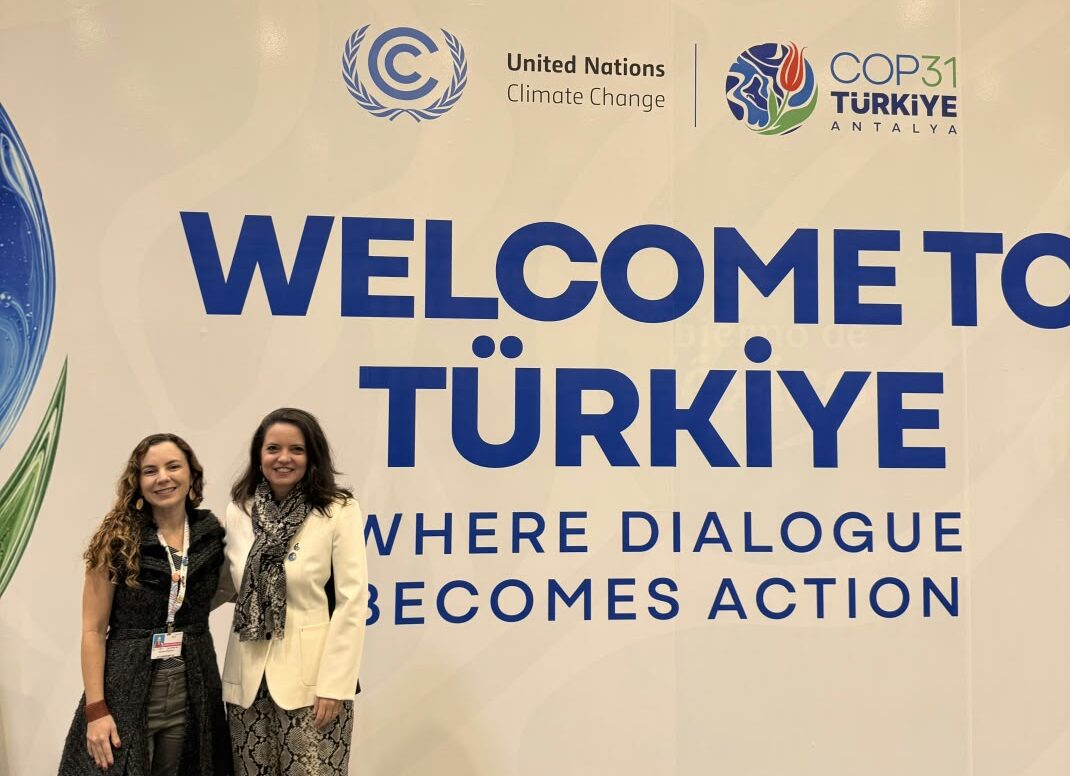
The reflections above were some of those we brought to the 31st United Nations Climate Change Conference (COP31) in Antalya, Turkey. On Thursday, November 19, we had the honor of participating—represented by our co-founder and executive director, Mariana Madureira—during the panel “Tourism Climate Solutions: Regenerative Approaches to Climate Action in Tourism” (a free translation of “Abordagens Regenerativas Para a Ação Climática no Turismo”). The discussion was organized by the Brazilian Ministry of Tourism as part of UNWTO’s thematic program.
Held in the Mutirão Global Auditorium at the Brazil Pavilion, the event brought together Mariana, Augusto Rocha, National Secretary for Tourism Policy at the Ministry of Tourism; Jaqueline Gil, CEO of Amplia Mundo; and Cristina Núñez Cuesta, Director of Strategy at NECSTouR (Network of European Regions for Sustainable and Competitive Tourism). Jeremy Smith, a specialist in climate action in tourism and a contributor to UNWTO, moderated the event.
Regenerative tourism as a tool for climate justice
Those who contribute the least to climate change are often the ones who suffer the most from its consequences. This is a reality found in many of the regions where we operate, and it prompts us to reflect on tourism’s responsibility in the face of socio-environmental inequalities.
Invited to speak from this perspective, Mariana shared examples of how regenerative tourism can promote climate justice in communities. Among the issues that guided her remarks were the role of community-based tourism in this process and the possibilities for developing climate adaptation solutions originating from the communities themselves.
The panel also facilitated an exchange of experiences between Brazil and Europe, bringing together different perspectives on the incorporation of regenerative principles into public policy and the management of tourist destinations.

UN World Tourism Organization and MTur Present Publication on Regeneration
One of the highlights of the meeting was the Ministry of Tourism’s presentation of the key findings and recommendations from the publication Regenerative Approaches to Climate Action in Tourism (Regenerative Approaches to Climate Action in Tourism).
The document was developed by UN World Tourism Organization in collaboration with the Brazilian Ministry of Tourism, as part of the One Planet Sustainable Tourism program. Its participatory development process was announced during COP30 in Belém in 2025 and included a public consultation between January and May 2026.
From Belém to Antalya: Our Commitment to Climate Action
A year ago, during COP30, we formally endorsed the Glasgow Declaration on Climate Action in Tourism. This November, we launched our Climate Action Plan, which sets out 12 goals for our efforts, with a timeframe from 2026 to 2035 and annual reviews.
Being back at a United Nations Climate Change Conference—this time contributing to an international debate on regenerative tourism at the invitation of the Ministry of Tourism—is a source of great joy for our entire team. It is recognition of our nearly two-decade-long commitment to sustainable development.
Would you like to learn more about how we work?
Browse our projects and learn about the initiatives we’ve developed in partnership with local communities.