
Last Friday, July 7, was the last of the five meetings that made up the first edition of the Raízes book club. We chose to open this initiative with Teaching Community: A Pedagogy of Hope, a work by the American bell hooks, teacher, feminist theorist, artist, anti-racist activist, and author of more than 30 books – including the famous All About Love. In other words: an incredible woman who is admired all over the world.
The idea for the book club was inspired by internal conversations at Raízes about the desire to discuss relevant topics with people from our community, beyond just the fixed and project management team. In order for this to happen, we thought we’d form this group from time to time, which meets at certain intervals to talk about a specific book. The titles are selected and read by everyone, in full or in part.
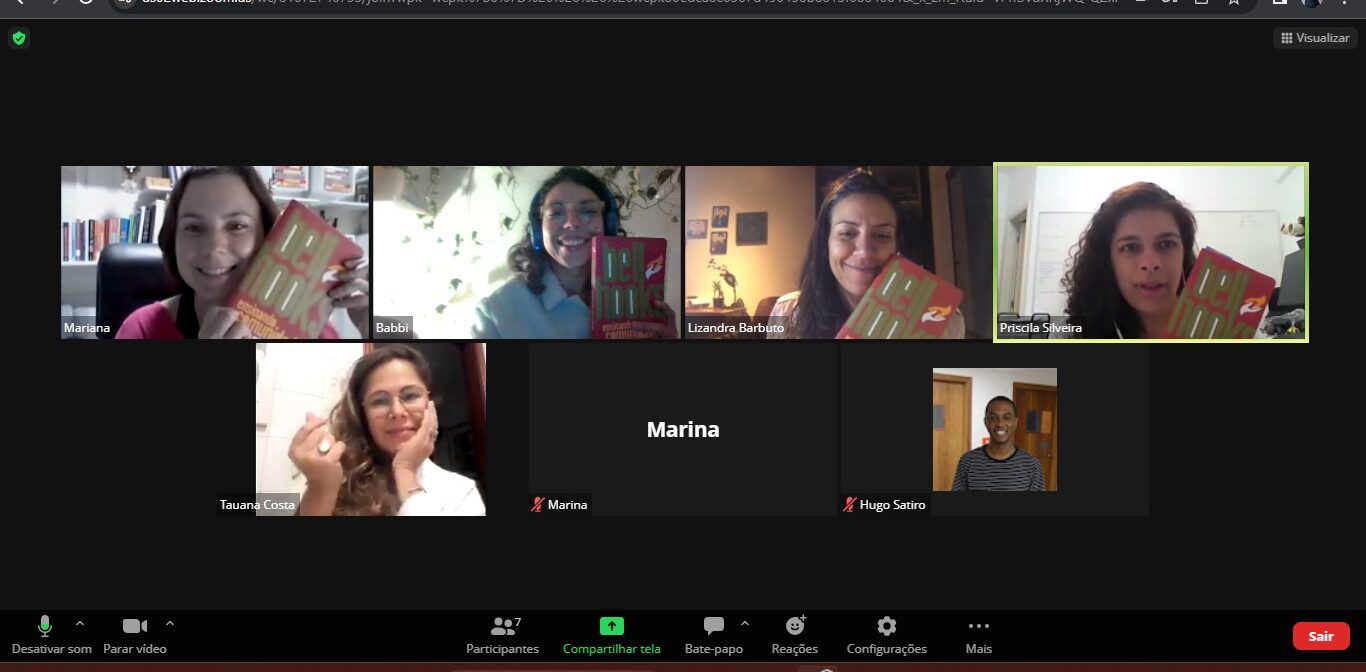
With the proposal in mind, we went into it! This first class included Andreia Duarte, Anna Ferreira, Barbara Ataide, Bruna Canal, Hugo Satiro, Isabel Damaceno, Jussara Rocha, Lizandra Barbuto, Mariana Madureira, Marina Claus, Priscila Silveira and Tauana Costa.
“Reading the book alone here, but knowing that I was inside a network, gave me a lot of encouragement to keep going. Reading this book has helped me a lot over the last few months, when a lot has happened to me and my work”, commented Bruna.
Insights into Teaching Community
Throughout the book, bell hooks shares her experiences as a teacher, as well as her own as a student. At all times, she contextualizes the scenario of racial segregation in the United States. She also talks about the challenges facing teachers who are effectively interested in collaborating with the anti-racist struggle and breaking down the paradigms of domination.
hooks shares her perceptions with accounts of difficult experiences such as abuse and prejudice in academia, the reproduction of power patterns, the authoritarianism of the academic system, and, with this, the difficulty of maintaining one’s own motivation at times. It also reinforces “living in a community”, which doesn’t just mean living with those who have the same experiences or think the same way as you; on the contrary, it’s also about dealing harmoniously with adversity.
Above all, it speaks of hope. And in this sense, the group found this “hope” and joy in “non-serious” education interesting. With her reflections, the author offers positive, possible solutions along the lines of Freirean hope – in reference to Paulo Freire, the Brazilian educator and philosopher whom she cites several times in her work. Despite the rather US-driven context of the book, we were still able to make some connections with the work of our social business, especially about dealing with the other through the path of dialogue and understanding, as well as pursuing the anti-racist struggle.
“The culture of domination has tried to feed fear within us, tried to make us choose security over risk, similarity over diversity. Displacing this fear, discovering what connects us, reveling in our differences; this is the process that brings us together, that offers us a world of shared values, of a meaningful community,” bell hooks.
We’ll soon be announcing the opening of the next book club iteration and the work chosen. If you’re part of the Raízes community, you too can take part in it! Now, if you are among the wider group of people who follow us, we will share with you, as we are doing now, some of our learnings and reflections.
Have you read Teaching Community? Feel free to comment on our social networks and share your perceptions with us too.