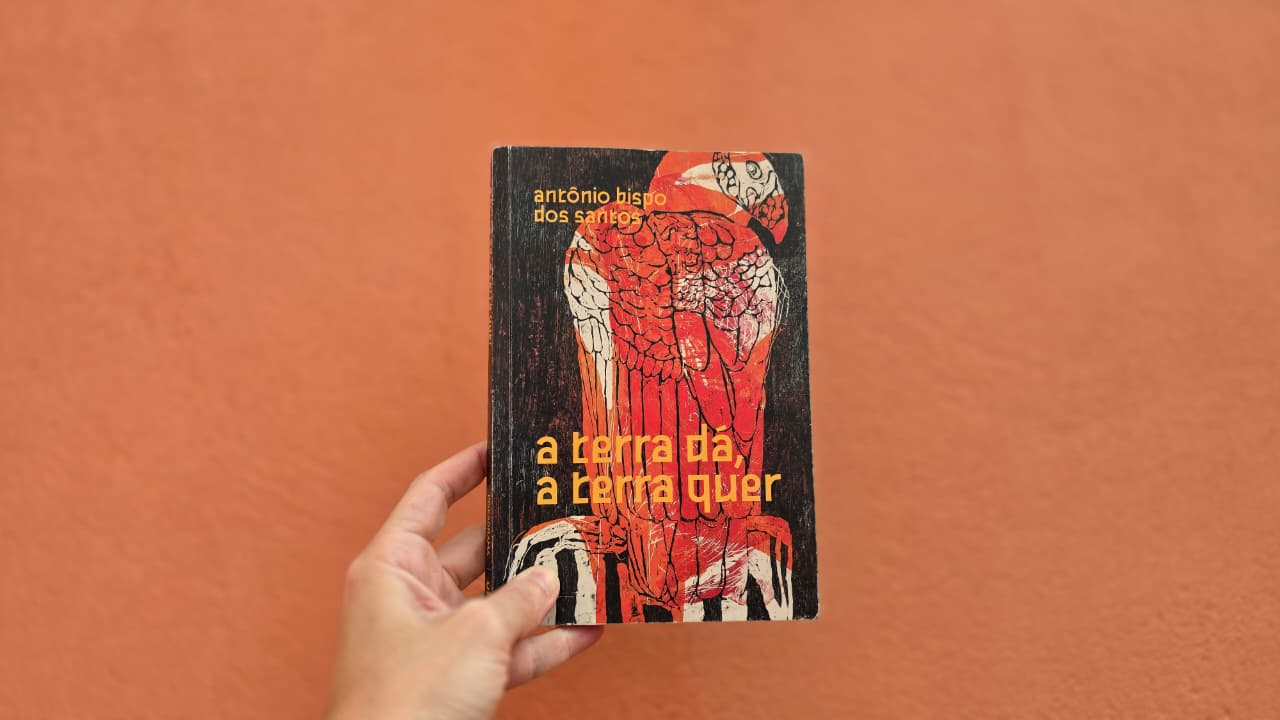
In our Book Club, reading is always an encounter: with ideas, with worlds that are not our own, and, above all, with ways of being that call us to rethink the present. In our most recent reading, we immersed ourselves in A Terra Dá, a Terra Quer, an essential work by the thinker, quilombola activist, and farmer Antônio Bispo dos Santos, known as Nego Bispo.
In the book, Nego Bispo presents counter-colonization as the key to understanding ways of life that predate and challenge colonial logic. Based on the Quilombo Saco Curtume, he encourages us to take a closer look at how we live, cultivate, and relate to the land. With language that germinates, the author questions urban cosmophobia, highlights disputes over naming, and rescues knowledge transmitted orally, weaving together themes such as territory, work, climate, and the cycle of life in a diverse and deeply rooted vision.
It was from this immersion that, over the course of two meetings, we allowed ourselves to open up important debates, the kind that broaden our perspective and make us reconsider the way we move through the world.

Language, territory, and the removal from the land
The reading prompts us to look at the “war of denominations,” a concept that Nego Bispo brings up to reveal how words shape realities and erase histories. From there, we open the conversation about how language is a political territory, a space of dispute and also of care.
This debate soon connected to ways of existing in traditional territories: the architecture of quilombola houses, the centrality of the kitchen, the lively backyard, the circulation of people. Nothing is random. Each spatial choice reinforces bonds, sustains community practices, and preserves knowledge. We realize how many urban projects, even well-intentioned ones, ignore these dynamics and end up designing futures disconnected from the relationships that matter.
The book also made us reflect on the impact of urbanization and technology on the lives of traditional communities and how this can lead to consequences such as the loss of imagination, the interruption of farming practices, and the arrival of consumption patterns that dismantle ancient relationships with the land.
While we search for ways to “return to nature” in the city, many communities are being pushed away from it. Between personal memories, experiences in the field, and collective concerns, we discuss how these silent displacements change both the territory and the way we inhabit the world.
Countercolonialism, cosmophobia, and the reminder that we are nature
Among the ideas that run through the book, countercoloniality appears as a turning point: it is not a response to colonialism along colonial lines, but a way of life that comes from before, sustained by a direct relationship with the Cosmos. In traditional peoples, humans are not above nature—they are within it. They are part of it. They are just one living being among many.
This view contrasts with cosmophobia, a concept that Nego Bispo uses to describe the fear of the cosmos that structures colonialist society. A fear that creates distances, separates humans from the environment, and transforms the city into an artificial space, designed for only one way of life. The city becomes a territory of control, exclusion, and rupture with natural cycles.
In this context, the title The Earth Gives, the Earth Wants takes on greater depth: it does not refer to a mechanical exchange, but rather to reciprocity. The earth offers, and those who receive must give back, not as an obligation, but as part of the circular movement of life. It is the opposite of the capitalist logic of accumulation. It is an ethic that reminds us that nothing exists alone and that every relationship involves care, limits, and giving back.
At the end of the meetings, it became clear that this book does not end with its pages. It provokes a generous shift, one that broadens our perspective and invites us to take further steps. There is a lightness in Nego Bispo’s writing that makes complexities accessible without losing depth. The session encouraged us to continue reading, explore other works by the author, and strengthen the habit of reading collectively.
Because certain narratives don’t just inform, they germinate. And this one, without a doubt, continues to grow within us.