
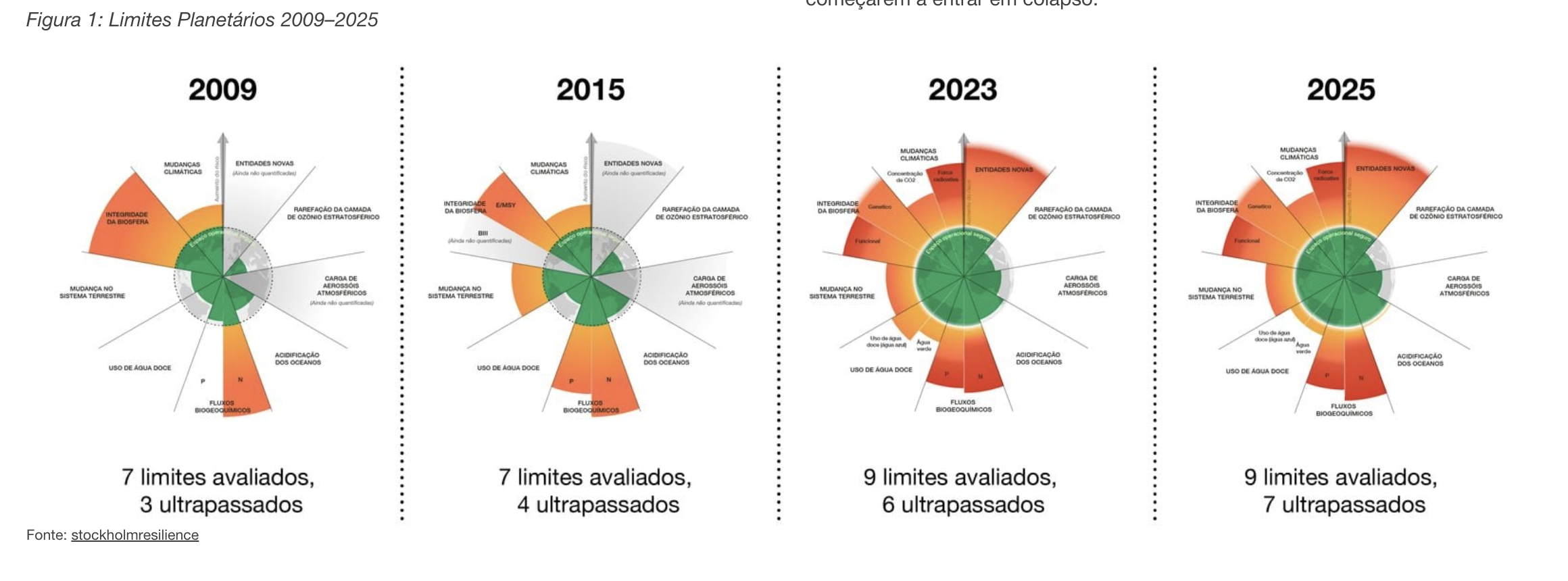
We are experiencing a crisis that goes far beyond numbers. The global economy, as it is organized today, operates at odds with the planet’s limits and people’s real needs. The result is a system that concentrates wealth, deepens inequalities, and pushes ecosystems to the point of collapse. Not surprisingly, scientific data indicates that humanity has already surpassed 7 of the 9 planetary boundaries, jeopardizing climate stability and the Earth’s very ability to sustain life.
This warning appears in a didactic and forceful way in the planetary boundaries model, widely disseminated by researchers and international networks committed to new economies. Recently, B Lab / Sistema B shared this diagnosis when it launched a new study called “The nature of business: climate and environmental practices of B Corporations.” You can download it for free here.
 Why talk about “reclaiming” the economy?
The campaign Reclaim the Economy (in Portuguese, Reivindique a Economia) starts with a simple yet powerful question: Who does the economy serve?
Reclaiming the economy means recognizing that it is not an abstract or inevitable force, but a social construct. And as such, it can (and should) be redesigned to serve collective well-being, social justice, and ecological balance. This international mobilization proposes a turning point: moving away from an extractive model geared toward infinite growth and advancing toward regenerative economies capable of restoring ecosystems, strengthening communities, and respecting the Earth’s limits.
Regenerating economies: from concept to practice
At Raízes, this debate is not new. It spans research, publications, and concrete actions that connect local development in different territories. One example is the e-book on regeneration, which brings together reflections and possible paths to regenerate not only nature but also economic relations. Among the highlights is the text “Regenerating the economy,” which delves into how regenerative principles can guide public policies, community initiatives, and businesses committed to positive impact.
The publication directly addresses this global moment of paradigm shift, showing that other economies are already being experimented with, many of them based on territories, traditional knowledge, and collaborative practices. You can download the e-book for free here.
Global connections, diverse voices
This debate takes on an international dimension through networks such as Wellbeing Economy Alliance (WEAll) and Post-Growth Institute, which coordinate research, campaigns, and publications on economies of well-being, post-growth, and regeneration. Last week, a virtual WEALL meeting marked the start of the campaign, which will involve actions in various locations around the world.

Imagem: https://www.reclaimtheeconomy.org/
Our director Mariana Madureira participated in this meeting and has been sharing some of this content—including on indigenous tourism and new economies—in English on LinkedIn to broaden the reach of these reflections beyond the Brazilian context.
In Brazil and elsewhere, it is possible to strengthen the movement by signing the petition!
The idea is that various voices around the world echo this need to think about (and apply) other economies.
To demand the economy is, in essence, to demand life!