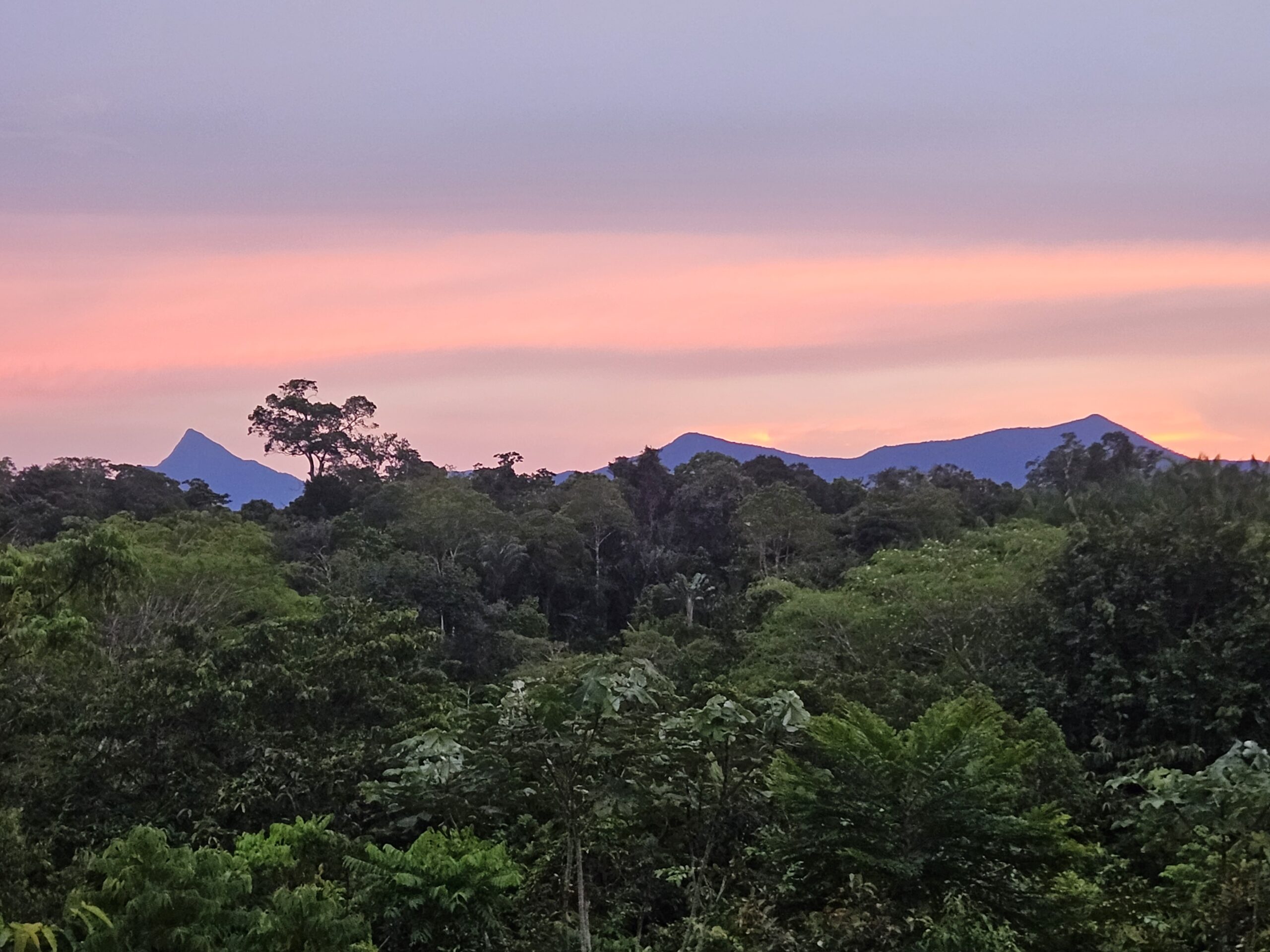
Did you know that Brazil’s highest point is operated by an indigenous people who have only recently been contacted? Pico da Neblina, also called Yaripo by the Yanomami, is located on the border between Brazil and Venezuela, within the territory of the Yanomami people and the Pico da Neblina National Park.
Until about 50 years ago, the Yanomami lived without permanent contact with non-indigenous society, and today they are protagonists in one of the most challenging and beautiful experiences of community-based and adventure tourism in the country.
The expedition to the summit involves approximately nine days of hiking through the Amazon rainforest, crossing rivers, flooded areas, and dense trails. It is a demanding itinerary that combines physical effort, complex logistics, and a direct relationship with the territory. But what sustains this experience goes far beyond adventure.

The Yanomami territory and its relationship with the forest
The Yanomami live between Brazil and Venezuela, in one of the largest indigenous lands in the world. According to the Socio-Environmental Institute (ISA), the Yanomami Indigenous Territory is home to around 30,000 people and plays a central role in the conservation of the Amazon rainforest.
The relationship between these people and their territory is deeply integrated into their worldview. As described by Davi Kopenawa in The Falling Sky, the book discussed at the Raízes DS Book Club In 2025, “the forest is not just a physical space, but a living system, inhabited by spirits, memories, and relationships. The mountains, rivers, and forests are part of the same network of existence.”
This understanding helps explain why any economic initiative, including tourism, needs to be carefully thought out, with dialogue and respect for the limits of the territory.
Tourism in Yaripo takes place in a rare context of overlaps. It is both an Indigenous Territory and a Federal Conservation Unit—a National Park managed by the Chico Mendes Institute for Biodiversity Conservation (ICMBio).
Visitation is regulated by a Joint Normative Instruction (INC) from ICMBio and the National Indigenous Peoples Foundation (FUNAI), a recent instrument that seeks to address the specificities of tourism on indigenous lands within Conservation Units. In addition, the region involves other institutional actors, such as the Brazilian Army, which is present in the border area between Brazil and Venezuela.
This structure reveals the complexity of operating tourism there—nothing is simple, nor should it be.

Challenges for developing tourism
Yaripo Ecoturismo operates in one of Brazil’s most remote and expensive destinations. Just getting there by land and river can cost over R$24,000 (circa 4.5k USD). This poses clear challenges in terms of competitiveness and market access.
There are also challenges of qualification and translation between worlds. The Yanomami, who until a few decades ago had no contact with capitalist logic, now run a business that needs to engage with accredited operators, tourist expectations, and institutional rules. At the same time, this business only makes sense if it is aligned with the values, time, and form of organization of the people themselves.
Thinking about tourism in this context means dealing with limitations all the time.
It was against this backdrop that the Yaripo Ecotourism Business Plan was revised, a collective effort carried out in the village of Maturacá, alongside the Yanomami people and the Socio-Environmental Institute, a leading organization working with indigenous peoples in Brazil.

Raízes was invited to contribute to this process and conducted a week-long immersion in the territory, with four workshops facilitated by our executive director Mariana Madureira and our consultant. Ricardo Cerqueira. The work was based on the current Business Plan and was directly linked to the update of the Visitation Plan prepared by FUNAI and ICMBio.
The importance of this joint effort lay precisely in the method: listening, exchanging ideas, and reaching agreements. Sensitive issues—such as pricing, inflation, indexation, community funds, and the use of resources—were discussed based on everyday tourism practices and the community’s real concerns.
One of the key points was the collective understanding of percentages and planning. By understanding how these calculations work and what they are used for, the group made progress in terms of management autonomy and clarity regarding the use of resources.
There was also room to look at the visitor. Identifying who the tourist is, what they are looking for, and what their needs are required a shift in perspective, worked on using simple tools such as the empathy map and a lot of conversation.
Results, agreements, and permanence
At the end of the process, adjusted values were agreed upon for the new visitation plan table, in addition to recommendations delivered to ISA to strengthen Yaripo Ecoturismo as a community-based business, aligned with the territory and viable within the market.
More than a technical document, the revised plan expresses a collective agreement. An understanding built by many hands, respecting the territory, culture, and boundaries involved.
Pico da Neblina will remain there. So will the forest. We therefore hope that initiatives such as this will help the Yanomami people to remain in their territory with autonomy and the conditions to continue caring for what sustains life.
When tourism meets the territory, it ceases to be merely an economic activity and becomes a tool for permanence.